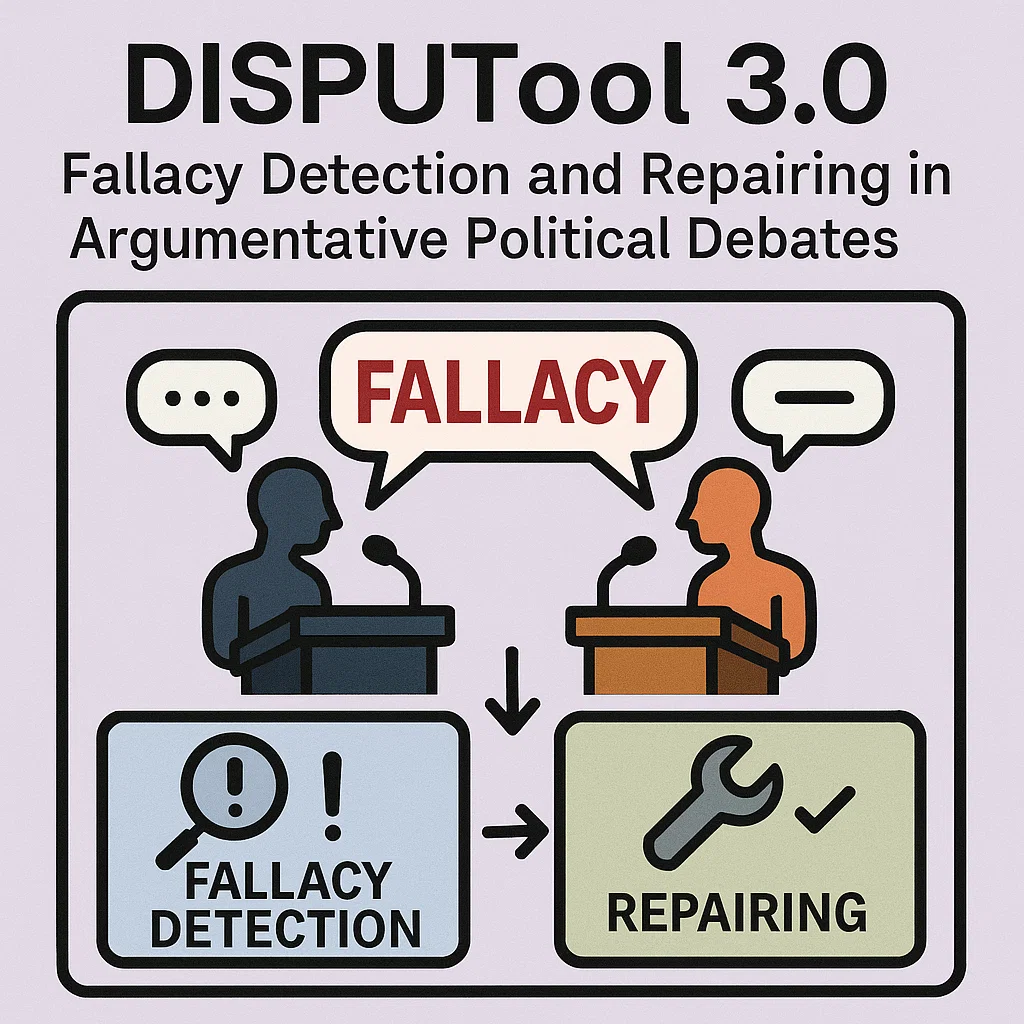
Fallacy detection and repairing in argumentative political debates.
Try the demoPaperPosterACL 2025, System Demonstrations · with Pierpaolo Goffredo, Elena Cabrio and Serena Villata
The question
Telling a reader that an argument is fallacious is only half the job. Can a tool show what the argument would look like once the fallacy is removed, so that readers learn to recognise the pattern themselves?
What it does
DISPUTool is a public web tool, built at Inria and 3IA Côte d’Azur, for exploring the argumentation in US presidential debates from 1960 to 2020 (the ElecDeb60to20 corpus). It mines argument components and the relations between them. Version 3.0 adds a module that:
detects fallacious arguments and classifies them by fallacy type;
repairs them, rewriting each argument so that it makes the same point without the fallacy.
We evaluated the module with automatic metrics and human assessment. The aim is to support critical thinking in front of misleading arguments, in political debates and beyond.
Papers
DISPUTool 3.0: Fallacy Detection and Repairing in Argumentative Political Debates
Pierpaolo Goffredo, Deborah Dore, Elena Cabrio, and Serena Villata
In Proceedings of the 63rd Annual Meeting of the Association for Computational Linguistics (Volume 3: System Demonstrations), ACL 2025, Vienna, Austria, July 27 - August 1, 2025, 2025
This paper introduces and evaluates a novel web-based application designed to identify and repair fallacious arguments in political debates. DISPUTool 3.0 offers a comprehensive tool for argumentation analysis of political debate, in- tegrating state-of-the-art natural language pro- cessing techniques to mine and classify argu- ment components and relations. DISPUTool 3.0 builds on the ElecDeb60to20 dataset, cover- ing US presidential debates from 1960 to 2020. In this paper, we introduce a novel task which is integrated as a new module in DISPUTool, i.e., the automatic detection and classification of fal- lacious arguments, and the automatic repairing of such misleading arguments. The goal is to show to the user a tool which not only identifies fallacies in political debates, but it also shows how the argument looks like once the veil of fallacy falls down. An extensive evaluation of the module is addressed employing both auto- mated metrics and human assessments. With the inclusion of this module, DISPUTool 3.0 ad- vances even more user critical thinking in front of the augmenting spread of such nefarious kind of content in political debates and beyond. The tool is publicly available here: https: //3ia-demos.inria.fr/disputool/
Repairing Fallacious Argumentation in Political Debates
Pierpaolo Goffredo, Deborah Dore, Elena Cabrio, and Serena Villata
In Argumentation in the Digital Society: Proceedings of the 5th European Conference on Argumentation, Sep 2025
Fallacious arguments are defined as “invalid” arguments (e.g., the conclusion does not follow from the premises) or wrong moves in argumentative discourse. This kind of argumentation is therefore misleading or deceptive, in particular when employed in political debates. As the spreading of this nefarious content severely impacts the society and the decision-making of both citizens and policymakers, it is vital to prevent fallacious and propagandist arguments to circulate. To address this challenging task, several approaches proposing to identify fallacious argumentation in text have been presented in the literature. However, merely identifying this content is insufficient to ensure the audience realizes the impact of the fallacious argument on its deliberation process and to support the development of critical thinking skills. To tackle this challenging goal, it is necessary to unveil why a particular argument is fallacious and to demonstrate how it could be repaired as a valid, non-fallacious argument. In this paper, we address this key challenge by proposing a new task called repairing fallacious argumentation. The goal of this task is to modify statements that contain fallacious arguments into versions that are clearer, fairer, and free from any technique that could negatively persuade listeners. We carry out this task on political debates, where the need for this kind of solution is urgent. Our contribution in addressing this task is manifold: i) a novel dataset, FallacyFix, comprising repaired examples across various fallacy categories (Appeal to Fear, Appeal to Pity, Appeal to Popular Opinion, Flag Waving, and Loaded Language) based on the ElecDeb60to20-fallacy dataset; ii) modular prompt techniques for generating non-fallacious arguments, both dependent and in- dependent of the specific fallacy label being addressed. Through an extensive evaluation, we assess these techniques using the most widely used Large Language Models (in Zero-Shot, Few-Shot, and Fine-Tuning settings) and a standard baseline model (BART); iii) a rigorous evaluation framework to assess the accuracy of the generated non-fallacious argument repairing the fallacy in the original argument, with respect to the manually annotated benchmark of non-fallacious arguments we built from the ElecDeb60to20 dataset; iv) a human evaluation of the generated non-fallacious arguments to assess the acceptability of these arguments across three dimensions, i.e., Relevance, Suitability, and Cogency. Future research will focus on integrating domain-specific knowledge to address complex fallacy categories, further analyzing language models’ behavior in countering fallacies, and exploring real-time fallacy repair methodologies. These efforts aim to enhance our ability to address fallacies dynamically in various argumentation contexts, potentially improving the quality of public discourse and decision-making.